AI Brand Voice: Why Everyone Sounds the Same
10 min read
The evidence comes from Optimizely's 2026 global study, published in June 2026 and based on a survey of 2,003 B2B marketing leaders across seven markets. It found that two thirds of them, 66%, are concerned that AI is driving a convergence in brand voice and content quality.
Only 30% say their brand voice is genuinely unmistakable. And nearly half, 48%, now have AI fully integrated into their day to day, so the convergence has a fast engine behind it.
The same study found that one in four marketing leaders admits to publishing AI content they know is not on brand when a deadline hits. In the United States that rises to one in three. So the sameness is not only an accident of the tools. Teams can see it happening and ship it
anyway.
Key takeaways
- Brand voice drift is what happens when every tool writes from the same models, so your content converges with everyone else's.
- It is hard to spot from inside, because the writing reads fine. The gap only shows when you hold it next to a competitor's.
- In Optimizely's 2026 study, 66% of marketing leaders worry about brand voice converging, and only 30% call their own voice unmistakable.
- One in four leaders admits to publishing off-brand AI content under deadline pressure, rising to one in three in the United States.
- You can test your voice in an afternoon. Swap your logo for a competitor's and see whether anyone would notice.
What is brand voice drift?
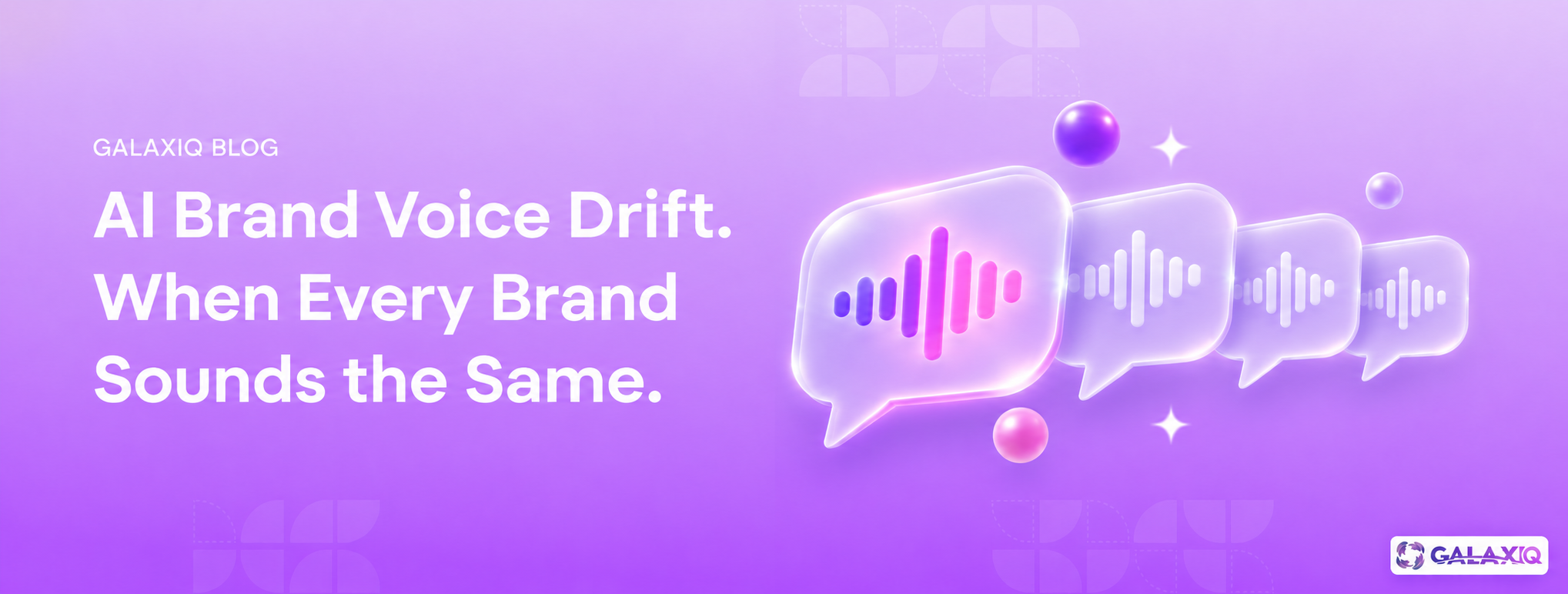
Brand voice is the consistent character of how a company sounds: its tone, rhythm, word choice and point of view, across every message a customer reads. Brand voice drift is the slow loss of that character. It is not a rebrand or a single bad campaign. It is the state you reach
when enough of your content is generated from the same general models that the edges wear off, and what is left sounds like the category average.
The tools are not the villain. Most teams use AI because it works, and 48% now have it fully integrated into their day to day. The problem is what they generate from. A general model has read most of the internet, so left to itself it writes the most likely sentence, not your sentence.
Without your brand loaded in, the most likely sentence is the average one.
| What your team sees | What is actually happening |
| Content that reads perfectly fine | It reads like everyone else's in your category |
| An AI tool set to “professionalˮ or “friendlyˮ | A generic register, not your actual voice |
| A brand guidelines document nobody opens | A rulebook the tools never read |
| Copy approved because nothing is wrong with it | Nothing is wrong, and nothing is distinctly you |
| A competitor's post that sounds oddly familiar | You are both writing from the same model |
Why most teams don't notice
Brand voice drift hides well, for three reasons.
Every piece reads fine on its own. You judge a caption or an email in isolation, where it looks correct. Drift only shows in aggregate, when a month of your content sits next to a month of a competitor's.
Teams overrate their own distinctiveness. In Optimizely's study, 85% of leaders believe their content would pass a logo swap test, where you replace your logo with a rival's and ask whether anyone would notice. Only 30% say their voice is genuinely unmistakable. The space between 85% and 30% is where the blind spot lives.
The tools sound confident. A general model writes fluent, assured copy, so the output feels like quality. Fluent and distinctive are not the same thing, and only a third of leaders are highly confident their current tools can capture their brand's emotional resonance.
Six symptoms of brand voice drift
If three or more of these sound familiar, your voice is probably drifting.
1. Your content could carry a competitor's logo. In Optimizely's study, 15% of leaders admit their content would probably fail the logo swap test, and many more have never run it.
2. Everything sounds “professionalˮ and nothing sounds like you. The default registers of general models are polite and neutral, which is where most output lands.
3. You ship copy you know is off brand. One in four leaders admits to it under deadline pressure, rising to one in three in the United States.
4. Your brand guidelines live in a document, not in your tools. The rules exist, but the thing writing the words never reads them.
5. You cannot tell your channels apart. The email, the ad and the social post all sound like the same generic source.
6. You worry about it quietly. Two thirds of leaders, 66%, share that concern, and in Australia it rises to around 79%.
What brand voice drift costs
Voice rarely shows up as a line in a budget, but the cost is real.
- Lost distinctiveness. If a reader cannot tell your post from a rival's, your content stops building your brand and starts building the category's.
- Weaker trust. A voice people recognise signals a real company behind the words. A generic voice reads as interchangeable, and interchangeable brands end up competing on price.
- Wasted reach. Every impression that sounds like everyone else is an impression that does not compound. You pay for the distribution and bank none of the recognition.
AI makes this worse, not better, when it runs on the average. A model that writes faster and at larger scale from a general base simply produces more of the sameness, sooner.
How to test your brand voice in an afternoon
Run these five tests on your own content. You do not need an agency, just a stack of recent posts and an hour.
1. The logo swap test. Take five recent posts, replace your logo and name with a competitor's, and ask a colleague whether anything feels wrong. If nothing does, your voice is not carrying the brand.
2. The side by side test. Put a month of your content next to a month of a direct rival's. If a stranger could not sort them into two piles, you are drifting.
3. The default test. Ask your AI tool to write a post with no brand instructions, then compare it to what you actually publish. The smaller the difference, the less of you is in the output.
4. The guideline test. Take one rule from your brand guidelines, such as a banned word or a signature phrase, and check your last ten pieces against it. Count the breaches
5. The new hire test. Give a new starter three unlabelled captions, one yours and two from competitors, and ask which is yours. If they cannot pick it, neither can your customers.
How tools try to hold a brand voice
There is no single fix for brand voice drift, and each kind of tool approaches it differently. The table below is a fair reading of how each one works, based on each vendor's own description, checked 29 November 2026.
| Approach | How it works | Trade-off |
| Brand voice in a writing tool (Jasper, Copy.ai) | You teach it your voice from samples or a URL, and it applies that voice when you generate content | As consistent as the person prompting it, and the voice lives inside one writing app, not across every channel |
| Enterprise style governance (Writer) | You build style rules, terms and a voice, enforced as live suggestions across teams and apps | Strong for consistency and compliance at scale, but heavier to set up and built for large organisations |
| A brand management hub (Frontify) | People upload guidelines, logos and assets to one shared library for teams to follow | A reference humans must remember to use. It stores the rules, it does not write or check the words |
| Brand monitoring (Brandwatch, Sprout Social) | It tracks mentions and sentiment about you across the web | It watches how others talk about you, not how you sound when you talk |
| Brand intelligence in the platform (GalaxiQ, BrandForge) | It audits your website, reads your voice, tone, keywords and competitors, then feeds that to every tool that creates | Newer and narrower than a dedicated writer. The value is shared context across the platform, not standalone depth |
The approaches can work together, because a governance tool and a writing assistant solve different parts of the problem. What matters is the end state: your brand loaded into whatever writes the words, so the default output is your voice and not the category average.
How GalaxiQ treats brand voice
GalaxiQ is an AI marketing platform with five products that share the same brand and customer context. BrandForge is the product that handles voice.
- One brand audit. BrandForge reads your website and returns a brand score, your voice and tone, the keywords you own and the competitors nearest you, in minutes rather than a workshop.
- One voice, shared everywhere. The voice BrandForge learns is handed to the other products, so campaigns in Ideanise, conversations in Aivora and journeys in EdgeIQ all write from the same brand, not a general model.
- A default that is yours. Because the brand is loaded in before anything is generated, the most likely sentence the platform writes is your sentence, not the category average.
Load your brand once, and let it shape everything you make.
Now the cautious part. GalaxiQ was founded in Sydney in 2025, so our track record is shorter than the established writing and governance tools. A brand audit is only as good as the website it reads, so a thin or outdated site gives a thinner read. And BrandForge does not replace a brand strategist. It captures how you already sound, it does not decide how you should sound. Run the five tests above on our output too, the same as any other tool.
Frequently asked questions
Brand voice drift is the slow loss of a brand's distinct character when its content is generated from general AI models. The writing stays fluent, but it converges towards the category average, so it could belong to any company.