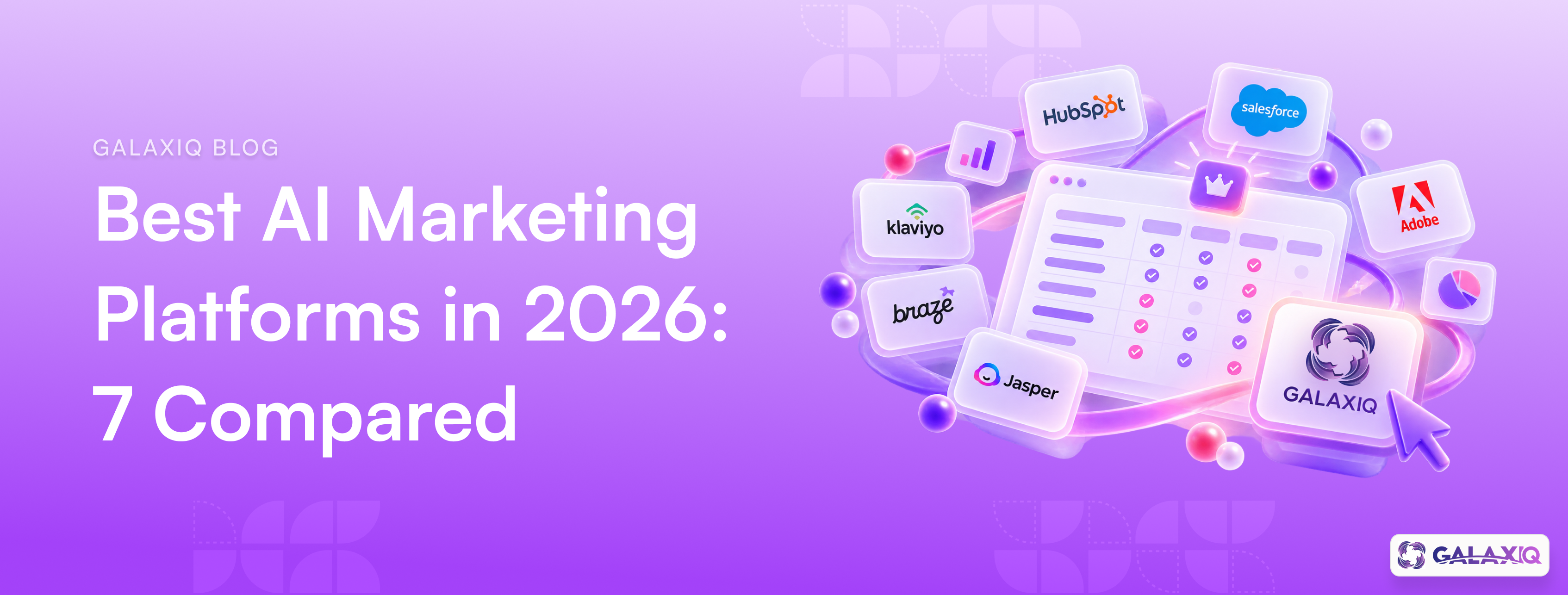
Best AI Marketing Platforms in 2026: 7 Compared
10 min read
The best AI marketing platform is usually the one that fits the system you already run your business on. If your CRM is HubSpot or Salesforce, start with their AI. If you're a creative-heavy Adobe shop, look at Adobe. If you sell online and live in email and SMS, look at Klaviyo or Braze. If your problem is that brand, data, campaigns, conversations and reporting are scattered across too many tools, look at an all-in-one platform like GalaxiQ.
Below are seven AI marketing platforms worth shortlisting in 2026, what each one is genuinely best for, and where each one falls short.
Key takeaways
- Every platform now ships AI content generation. The real differences are data, agents, brand control and how much of your stack each one replaces.
- Pick by your system of record first, then by the job you need AI to do.
- Big suites are powerful but often need specialists to implement. Newer platforms are faster to start but have shorter track records.
- Whatever you choose, test it on your own data before you sign.
How we compared these platforms
We looked at each platform's own product pages (checked 22 October 2026) and asked five questions:
1. What's the core job? CRM, customer engagement, content, or all of these together.
2. Does it have AI agents that complete multi-step work, or mainly assistants that draft?
3. How does it keep AI output on-brand?
4. What data does the AI work from? Its own CRM, a customer data platform, or your content only.
5. Who is it really built for?
We've left out prices on purpose. They change often, vary by region and contract size, and most enterprise plans are quoted, not listed.
One more thing worth saying up front: we make one of these platforms. We've tried to be fair, and we've said where GalaxiQ isn't the right choice.
1. HubSpot (Breeze and Agent Hub)
Best for: small to mid-sized B2B teams already running on HubSpot's CRM.
HubSpot's AI sits on top of its CRM. Its Agent Hub brings together ready-made agents for marketing, sales and service, including a campaign agent that plans campaigns, a content agent that creates them and a nurture agent that follows up. You can also build custom agents from your own prompts and knowledge.
Why teams pick it: the agents work on live CRM data from day one, with no separate data setup.
Watch out for: the AI is at its best when everything lives inside HubSpot. If your customer data sits elsewhere, you'll need to bring it in first.
2. Salesforce Marketing Cloud (Agentforce)
Best for: large enterprises already invested in Salesforce.
Salesforce positions Marketing Cloud around "agents that act". You set the goal and guardrails, and its Campaign Agent generates content for each channel, builds campaigns from your brand guidelines and optimises as it sends. Its customer data platform, Data 360, unifies customer signals for both people and agents.
Why teams pick it: depth. It can handle complex data, many brands and many markets, and it connects to sales and service on the same data.
Watch out for: implementation effort. Large Salesforce rollouts usually involve specialist partners and take time to configure well.
3. Adobe GenStudio for Performance Marketing
Best for: creative-heavy enterprises that produce a lot of ad and email variants.
Adobe GenStudio for Performance Marketing focuses on producing on-brand creative at scale. It generates copy, image and video variants for social, display and connected TV, checks every ad or email against your brand voice, accessibility and regulatory rules before it goes live, and activates approved assets to platforms like Meta, LinkedIn and Google.
Why teams pick it: strong brand governance for creative production, and tight links to the rest of Adobe's tools.
Watch out for: it's built around content production and activation. Customer data, journeys and conversations sit in other Adobe products, so value depends on how much of the Adobe stack you already run.
4. Klaviyo
Best for: e-commerce and consumer brands that drive revenue through email, SMS and other owned channels.
Klaviyo calls itself a B2C CRM and AI marketing platform. Its AI marketing agent, Composer, audits your flows, segments and forms from one prompt and builds an on-brand campaign. Its Customer Agent handles customer service questions around the clock. Its data platform unifies behavioural, transactional and engagement data.
Why teams pick it: marketing, service and customer data in one place, built specifically for online retail.
Watch out for: it's designed for B2C and e-commerce. B2B teams, or businesses that don't sell online, will get less from it.
5. Braze
Best for: consumer brands, especially mobile-first apps, that need real-time messaging across many channels.
Braze is a customer engagement platform. Its data platform connects customer signals in real time so teams can act the moment it matters, BrazeAI adds AI across the platform, and campaigns run across channels from one place.
Why teams pick it: speed and scale for real-time, cross-channel messaging.
Watch out for: it's an engagement platform, not a full marketing suite. You'll still need separate tools for brand analysis, content creation and deeper analytics.
6. Jasper
Best for: content and brand teams whose main need is producing on-brand content at scale.
Jasper is an AI content platform for marketers. It offers purpose-built agents for marketing workflows, brand controls (brand voice, visual guidelines and style guide), content pipelines for repeatable production, and tools to measure how your brand shows up in AI answer engines.
Why teams pick it: strong brand-voice controls and content workflows that non-technical marketers can use.
Watch out for: it's content-first. It isn't a CRM or customer data platform, so segmentation, journeys and customer conversations happen in other tools.
7. GalaxiQ
Best for: teams that want brand intelligence, customer data, campaigns, customer conversations and analytics in one platform, without a big data team.
GalaxiQ is an enterprise AI marketing platform made up of five connected products:
- BrandForge audits your brand and feeds your voice to every other product
- EdgeIQ tracks customer behaviour in real time and builds segments with an AI segmentation agent, Atlas
- Ideanise turns one idea into a full campaign with posts, visuals and a content calendar
- Aivora runs chatbots and voice agents trained on your business, with human takeover
- InsightIQ answers questions about your marketing data in plain English
Why teams pick it: the products share context. Your chatbot uses your brand voice, your campaigns use your segments, and your reporting covers all of it. You can also start with one product and add more later. (Here's a fuller explainer: what is GalaxiQ? (/blog/what-is-galaxiq/))
Watch out for: GalaxiQ was founded in 2025, so it's a newer platform than the others on this list. Ask for a demo on your own data and check that it connects to the tools you rely on.
Which AI marketing platform should you choose?
A simple shortcut is to start from the system you already run your business on:
- Your CRM is HubSpot: start with HubSpot's agents.
- Your CRM is Salesforce: start with Marketing Cloud and Agentforce.
- You're an Adobe creative shop: start with GenStudio.
- You're an online retailer living in email and SMS: compare Klaviyo and Braze.
- Content production is the bottleneck: look at Jasper.
- Your tools don't talk to each other, and you want one platform for brand, data, campaigns, conversations and reporting: look at GalaxiQ.
Defaults aren't destiny, though. If the platform you're "supposed" to use isn't solving the problem, an alternative deserves a fair trial.
What to check before you sign
Whichever platform you shortlist:
- Test it on your own data. A demo on sample data tells you very little.
- Check brand control. Ask how it stops AI content from drifting off-brand, and ask to see the controls.
- Ask what the AI can actually do on its own, and where a human approves. "Agent" means different things to different vendors.
- Check where your data comes from. Segments built on thin or messy data won't perform. (More in our guide to AI customer segmentation
- Check the reporting. Can you ask questions in plain English and see where every number came from?
- Count the total cost, including setup, integration, training and the people needed to run it, not just the licence.
Frequently asked questions
There isn't one best platform for everyone. HubSpot and Salesforce suit teams already on their CRMs, Adobe suits creative-heavy enterprises, Klaviyo and Braze suit consumer brands focused on owned channels, Jasper suits content teams, and GalaxiQ suits teams that want brand, data, campaigns, conversations and analytics in one platform.