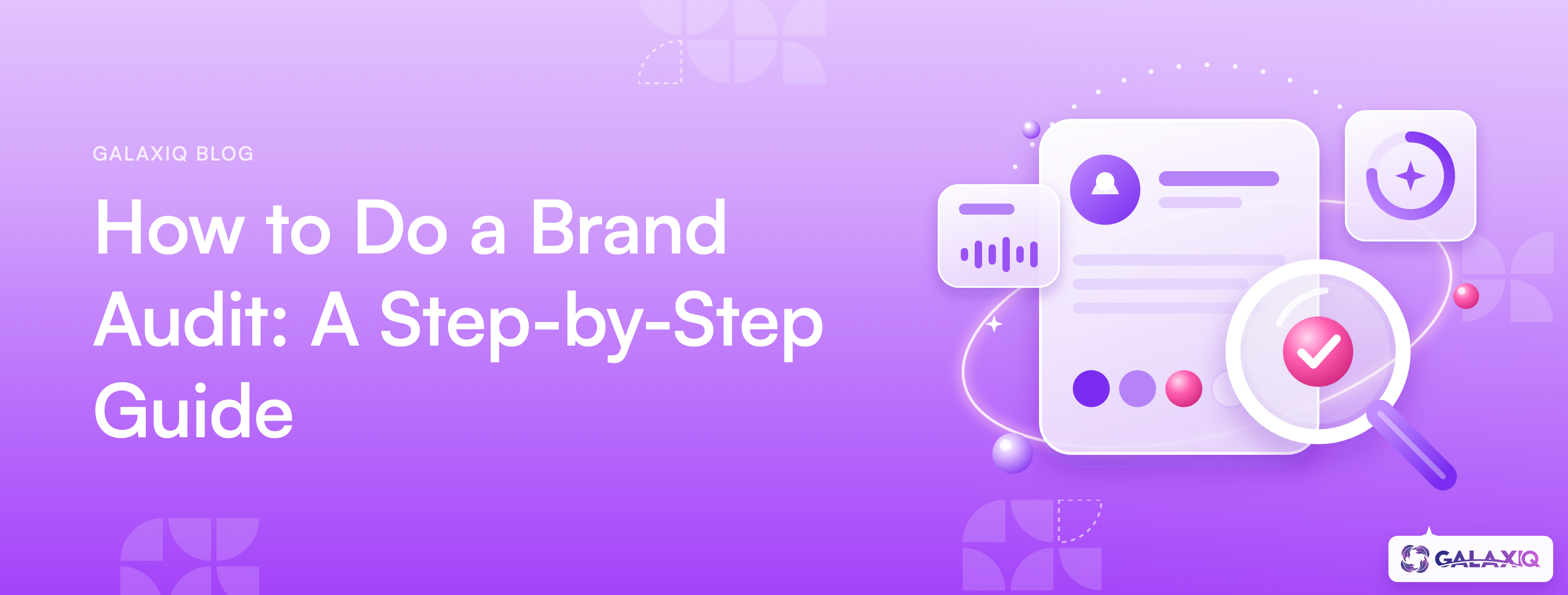
How to Do a Brand Audit: A Step-by-Step Guide
10 min read
A brand audit is a structured review of how your brand looks, sounds and performs everywhere customers meet it, compared with how you want it to be seen. To do one, gather every touchpoint, check it against your positioning, voice and visual identity, compare yourself with your closest competitors, and turn the gaps into a short list of fixes. A manual audit can take weeks. With AI, the first pass can take minutes.
Here's how to run one, with a template you can copy.
Key takeaways
- Most brands think they're consistent. In one study, fewer than 10% said their brand presentation was very consistent.
- A brand audit covers four things: positioning and messaging, voice and tone, visual identity, and how you compare with competitors.
- The output should be a ranked list of fixes, not a 60-page PDF nobody opens.
- AI can do the evidence-gathering. People still decide what the brand should stand for.
Why do a brand audit?
Because brands drift without anyone noticing. New people join, agencies change, channels multiply and each one interprets the brand a little differently.
The research backs this up. In a Demand Metric and Lucidpress study, fewer than 10% of organisations said their brand presentation was very consistent, even though almost 90% agreed consistency was important. Only a quarter had formal brand guidelines that were consistently enforced. The biggest cost of inconsistency, reported by 71%, was confusion in the market.
And the problem has grown with content volume. A later Lucidpress study found 81% of companies deal with off-brand content.
An audit tells you where the drift is, how big it is and what to fix first.
When should you audit your brand?
- Once a year as a health check
- Before a rebrand or repositioning, so you know what you're changing from
- Before rolling out AI content tools, because AI will scale whatever brand you feed it, inconsistencies included
- After a merger, new market launch or agency change
- When results dip and you suspect the message, not the media, is the problem
What a brand audit covers
| Area | What you're checking |
| Positioning and messaging | Does every touchpoint say the same thing about who you are, who you're for and why you're different? |
| Voice and tone | Do you sound like one company everywhere, from the homepage to the chatbot? |
| Keywords | Which words define you, and are they the words customers search for? |
| Visual identity | Are logo, colours, type and imagery used consistently? |
| Competitors | Who are you really competing with, and where are you ahead or behind? |
| Perception | What do customers, reviews and social conversations say about you? |
How to do a brand audit in 7 steps
Step 1: Write down the brand you intend to be
Before you audit anything, write one page on the intended brand: positioning statement, three to five messaging pillars, voice in three words, and your core visual rules. If this page doesn't exist, that's your first finding.
Step 2: Collect every touchpoint
List everywhere a customer meets the brand: website, social profiles, ads, email, sales decks, proposals, packaging, support macros, the chatbot, job ads and review sites. Take screenshots or links for each. You need evidence, not memory.
Step 3: Check messaging against your pillars
Go through each touchpoint and ask: which pillar does this support? Content that supports none of them, or contradicts one, goes on the fix list. Pay special attention to your homepage headline and your social bios, because they're the most-seen words you own.
Step 4: Score voice and tone
Read five pieces from five different channels in a row. Do they sound like the same company? Mark where the voice drifts: too formal in email, too casual on social, robotic in the chatbot. Tone can flex by context, but the voice underneath should not.
Step 5: Map your keywords
List the words that appear most often across your content, then compare them with the words customers actually use to search for what you sell. If your content says "solutions" and your customers search for "software", you have a gap.
Step 6: Benchmark your closest competitors
Pick three to five competitors and run the same checks on them. Where do you sound the same? Where are you clearly different? The overlaps are where you're easiest to forget.
Step 7: Turn findings into a ranked fix list
Rank every gap by impact and effort. Start with high-impact, low-effort fixes: homepage copy, bios, email signatures and chatbot answers. Assign an owner and a date to each. Then set a date for the next audit.
How AI changes the brand audit
The slow part of a brand audit is gathering and comparing evidence. That's exactly what AI is good at. An AI brand audit tool can read your website and content, extract your positioning and pillars, score how consistently you sound, rank your keywords and find your closest competitors, in minutes rather than weeks.
What AI can't do is decide what your brand should be. Use it to show you the gaps, then make the calls yourself. Once your brand rules are clear, the next job is keeping every new piece of AI content inside them. Our 5-layer framework for keeping AI content on-brand covers that.
Common brand audit mistakes
- Auditing without a written target. You can't measure drift from a brand that only exists in people's heads.
- Only checking the website. The chatbot, sales decks and support replies are often where the brand drifts most.
- Producing a report instead of a fix list. If the output doesn't have owners and dates, nothing changes.
- Ignoring competitors. Being consistent and indistinguishable is still a problem.
- Doing it once. Brands drift continuously, so the audit should be a habit, not a project.
How BrandForge by GalaxiQ does this?
BrandForge by GalaxiQ is the brand intelligence product inside GalaxiQ's enterprise AI marketing platform. It runs the evidence-gathering steps above automatically:
- Brand DNA: scans your website and content and pulls out your identity, positioning and core messaging pillars (steps 1 and 3).
- Voice and tone scoring: shows how strongly your voice holds and how well tone adapts by context, and where you drift (step 4).
- Keyword mapping: maps the keywords that define your identity, ranked by weight (step 5).
- Competitor benchmarking: auto-detects your closest competitors with confidence-scored matches and shows where you're ahead or behind (step 6).
- Ranked suggestions: surfaces AI suggestions ranked by their impact on your Brand Score, with exportable reports (step 7).
Because every other GalaxiQ product reads from BrandForge, the audit doesn't stay in a report. Ideanise writes campaigns in that voice and Aivora keeps chatbot answers on brand. (More on how the products fit together in what is GalaxiQ.)
Frequently asked questions
A brand audit is a structured review of how your brand appears and performs across every touchpoint, compared with how you intend it to be seen. It covers messaging, voice, keywords, visual identity, competitors and customer perception.